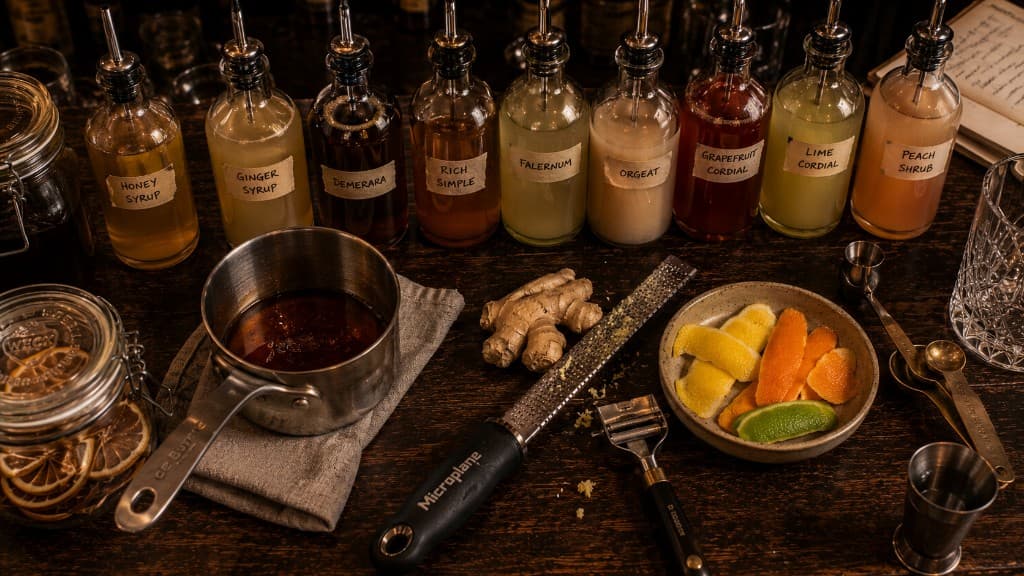
Most people learning cocktails focus on the bottles. The bottles get the attention because they're expensive, visible, and easy to understand. Nobody walks into a friend's house, sees their bar, and asks what's in the small glass bottle next to the bitters.
They ask about the bourbon.
But a working bar is rarely just bottles. It's syrups. Tinctures. Cordials. Oleos. Shrubs. Infusions. The preparations that sit between the spirit and the citrus and quietly do most of the work.
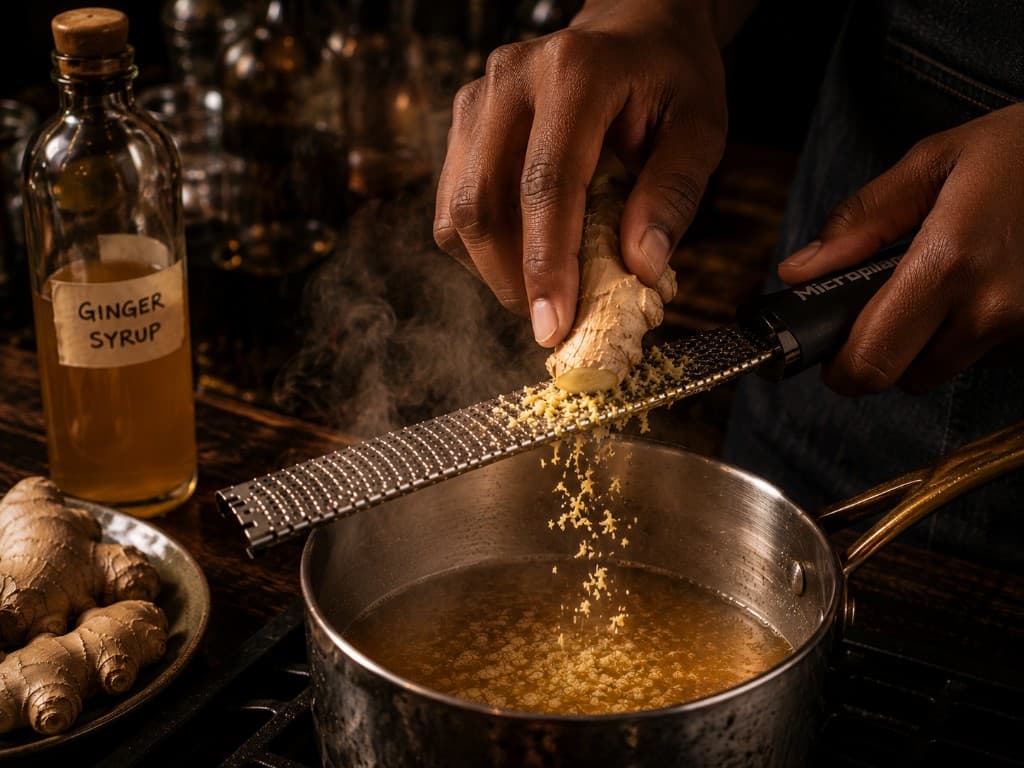
The first time you make a Penicillin with a fresh honey-ginger syrup, you understand this immediately.
Not honey from a squeeze bottle. Not ginger juice from a carton. A real honey-ginger syrup made that afternoon.
Same recipe. Same whiskey. Completely different drink.
The preparation is the difference. Plus you control the flavors. This is a chance to really get creative.
That's why Accoutrements has its own chapter.
Preparations are recipes
Nothing in this chapter is a cocktail, however, they are needed to make some very special drinks. This is also where you can start to make certain cocktails your own.
They have ingredients. They have methods. They have yields. They have shelf lives. Most importantly, other recipes depend on them.
That's the key idea.
Traditional cocktail books usually hide preparations inside the cocktail recipe itself. A Penicillin recipe includes a honey-ginger syrup recipe somewhere in the middle, which means every time you need the syrup you're looking for the Penicillin again.
The Bar Book treats preparations as separate recipes. The honey-ginger syrup gets its own page. The cinnamon syrup gets its own page. The orgeat gets its own page.
Once you understand the preparation, every cocktail that uses it becomes easier to understand too.
Building infrastructure
This is the point where a home bar starts to feel different.
Just like any other recipe, the ingredients and the methods matter. When first starting out the key is to make the drink. When you understand how it tastes that is when the nuance of Accoutrements shines.
Make a bottle of honey syrup once and it can be used in a Bee's Knees, a Gold Rush, a Penicillin, and half a dozen other drinks. Make a bottle of orgeat and you've unlocked an entirely different family of recipes.
You're no longer building one cocktail. You're building the ingredients that support many cocktails.
The purpose of this chapter
The preparation becomes infrastructure. That's how professional bars think about prep work, and it's one of the habits worth stealing.
The categories
The Accoutrements chapter organizes preparations into a handful of families.
You don't need to memorize the categories. You'll encounter them naturally as recipes call for them. The categories exist to help organize the growing collection of preparations you'll encounter over time.
How the cabinet connects
Accoutrements are recipes, but they also behave like ingredients. When you make a preparation, you can add it to your cabinet just like a bottle of bourbon or a bottle of vermouth.
That matters because recipes can depend on it.
A Penicillin requires honey-ginger syrup. If the syrup isn't in your cabinet, the recipe knows you're missing something.
Once you've made it and added it, the recipe becomes available.
The same thing happens with orgeat, grenadine, oleo-saccharum, and every other preparation in the chapter. The cabinet doesn't just track bottles. It tracks the things you've made.
Shelf life matters
Preparations are usually more fragile than spirits.
A bottle of bourbon can sit on your shelf for years. A ginger syrup cannot.
Most syrups are at their best within a few weeks. Some preparations last longer. Some last less. The recipe pages include storage notes and shelf-life guidance because freshness matters.
A dull syrup produces a dull cocktail. A fresh syrup produces a better one.
The difference is often larger than people expect. That's one reason professional bars spend so much time on prep work.
The launch set
The Bar Book launches with the preparations that appear most often throughout the library.
Simple syrup. Demerara syrup. Honey syrup. Ginger syrup. Orgeat. Oleo-saccharum. A collection of classic tinctures and foundational preparations. These recipes are ready to read from day one.
After that, the chapter grows with you. Make a shrub you like. Save it. Create a cordial. Add it. Develop a syrup your House uses regularly. Keep it.
Over time the Accoutrements chapter becomes a record of the preparations your bar actually relies on.
At that point you've stopped thinking about cocktails as isolated recipes. You've started thinking about systems.
Your bar feels less like a collection of bottles and more like a kitchen.
That's the moment this chapter is built around.