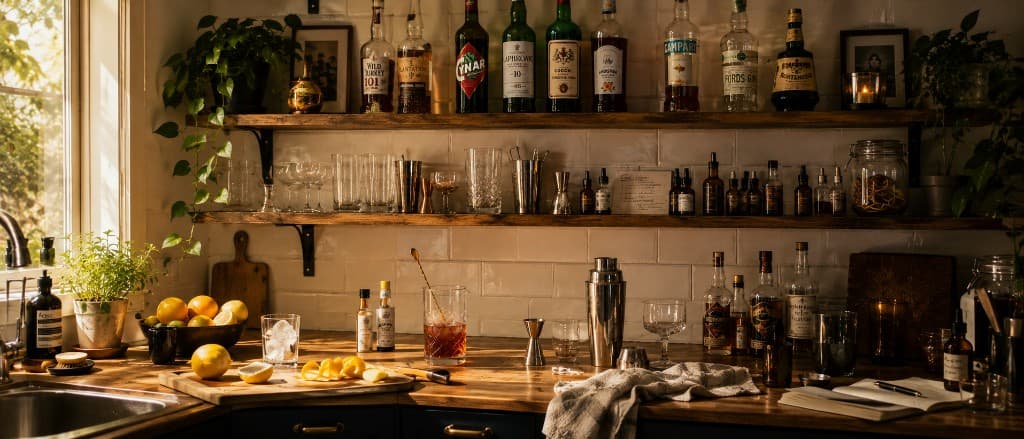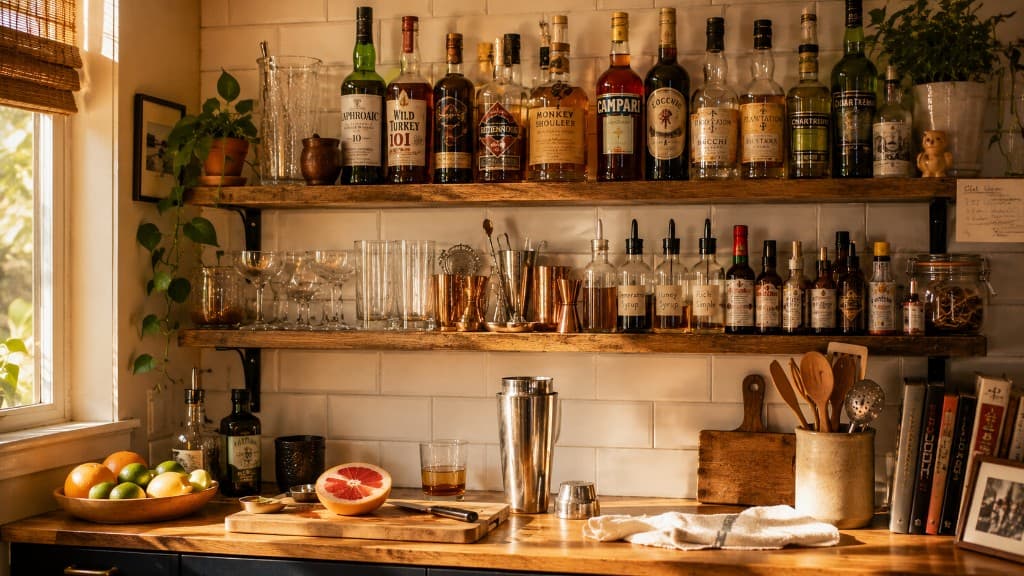
Every working bar has an inventory. This is about your home bar and the drinks you can make. You control the level of detail and what you want to track.
The Bar Cabinet is your library, and this expands further than just spirits and mixers. Save your accoutrements, fresh ingredients, and all of the fun things in your fridge — your bitters, wine and beer, and even your barware.
It's not a restaurant inventory system. It's not a spreadsheet. It's a working list of what's actually on your shelf.
Get the bottles in. Get the major mixers in. Add the rest over time.
That's the whole job.
What goes in the cabinet
Six kinds of things live in the Bar Cabinet.
Bottles & Guest Bottles
Spirits, liqueurs, vermouths, amari, bitters. If it comes in a bottle and shows up in a cocktail recipe, it probably belongs here.
Mixers & Accoutrements
Juices, syrups, sodas, shrubs, oleos, tinctures. Some you'll buy. Some you'll make yourself.
Fresh Ingredients & Garnishes
Citrus, herbs, olives, cherries, salts, sugars, pickle and olive brine, Worcestershire sauce. The most temporary part of the cabinet. Lemons come and go.
Bar Kit
Coupes, rocks glasses, Nick & Nora glasses, julep cups, shakers, jiggers, strainers, peelers. The tools that make a drink possible.
Wine & Beer
Reds, whites, bubbly, lager, ales, stouts, porters, etc.
Zero Proof
Non-alcoholic spirits, wines, beers, and bitters. This is a great place to keep your non-alcoholic drinks and bitters.
Recipes reference all of these things, and the matching engine can use them. Tracking your tools and glassware lets The Bar Book know, for example, that you can't serve a julep if you don't own a julep cup.
Categories, not brands
The Bar Book does not need a perfect database of every bottle ever made.
It needs to know what the bottle is.
If you add Buffalo Trace and mark it as bourbon, The Bar Book can use it as bourbon. If you add a bottle from a local distillery and mark it as rye, it can use it as rye. If you add an orange liqueur, it knows where that fits.
That is what makes the cabinet flexible. You can add familiar bottles, obscure bottles, local bottles, and bottles The Bar Book has never heard of. As long as they are categorized correctly, they can still be used.
The same idea applies to mixers, syrups, garnishes, and accoutrements. Once The Bar Book understands what something is, it can use it throughout the rest of the app.
Building your cabinet
The first setup is the only part that feels like work.
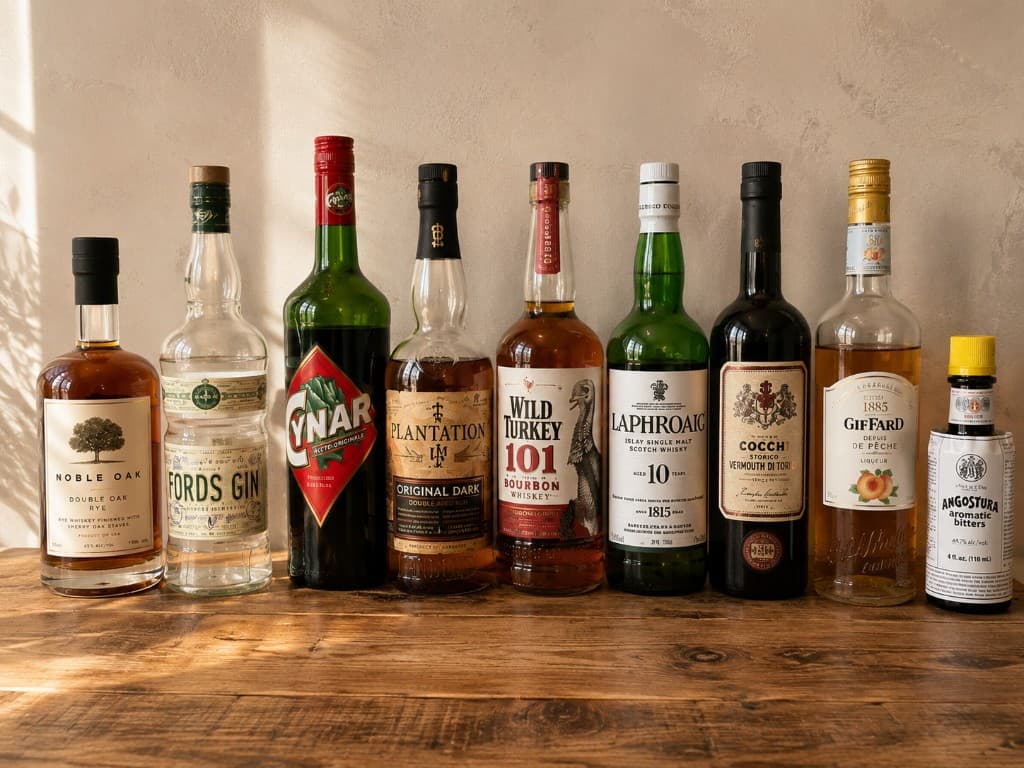
You can add things manually as you use them. You can spend fifteen minutes walking through your shelf and entering everything at once. Or you can take photos of your bottles with the labels showing and use an AI assistant like ChatGPT or Claude to help identify what you have.
That is usually the fastest way to start.
Take a few photos. Let the assistant read the labels. Then use that list to build your cabinet. You still need to confirm the categories, but you are not starting from a blank page.
The goal is not to create a museum of your bar.
The goal is to give The Bar Book a useful picture of what is actually available.
Bottle levels
The Bar Cabinet tracks enough quantity to be useful without turning into inventory accounting.
A bottle can be sealed, open, half, low, or empty.
That gives you a way to mark the difference between a fresh bottle of gin, the last pour of Cointreau, and something that needs to be replaced. It also lets The Bar Book surface ingredients that are running low without asking you to measure every ounce.
This is the right level of detail for a home bar.
If you want to see what you're about to run out of, open the Running Low/Expiring tab to see every item that's running low or expiring. How useful that is depends on how often you update your cabinet.
Mark the level honestly and move on. The cabinet should take seconds to update, not minutes.
Why the cabinet matters
The cabinet helps determine the shape of the rest of The Bar Book's abilities.
Once The Bar Book knows what you have, it can start helping you use it.
Let's say you add rye whiskey, sweet vermouth, Angostura bitters, and a lemon. The moment those ingredients are in your cabinet, The Bar Book can begin matching recipes against them. Some drinks become available immediately. Others become one ingredient away.
That is the practical purpose of the cabinet.
The more accurate your cabinet is, the more useful The Bar Book becomes.
The purpose of this chapter
Honest tracking, not perfect tracking
You do not need to catalog every dusty bottle you have owned for ten years.
Log the bottles you actually use. Log the syrups you actually make. Log the citrus when it is in the house and remove it when it is gone.
The cabinet is a working tool.
Treat it like the grocery list on your refrigerator. Its value comes from being current, not from being perfect.
Spend ten minutes adding your spirits. Spend another five minutes adding the mixers and syrups you keep around. Ignore glassware and tools for now if you want. Add them later when recipes start calling for them. Do not worry about garnishes until you make a drink and realize you are out of lemons.
By the end of your first week with The Bar Book, the cabinet should be taking shape. By the end of your first month, it should be genuinely useful. After that, it mostly takes care of itself.